
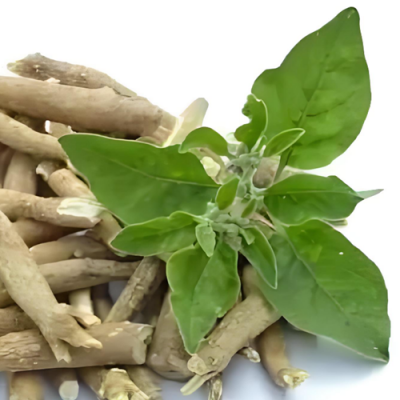
What is Ashwagandha?
The most common English name for this is Ashwagandha. It is also known as Indian Ginseng or Winter Cherry extract. The core active ingredient is Withanolides. Ashwagandha is a small shrub that mainly grows in parts of India, the Middle East, and Africa. The medicinal part is mainly the root. The active ingredients are extracted using solvents such as water or alcohol and made into powder for use in capsules or tinctures.
Main active ingredient: Withanolide
What is withanolides and it’s benefits ?
They belong to a class of compounds called “steroidal lactones”. Their chemical structure is similar to sterols in the human body (such as cholesterol) and phytosterols. They are found in the roots and leaves of Ashwagandha. Their core function is to regulate the stress response, modulate the HPA axis, and reduce the stress hormone cortisol in the body, thereby alleviating various problems such as anxiety, insomnia, weight gain, and immune dysfunction. In addition, they have anti-inflammatory and antioxidant properties, protect brain cells, improve memory and learning ability, regulate immunity, and have potential anti-tumor effects.
KosNature’s withanolides content in ashwagandha is 1%, 1.5%, 2.5%, and 5% as determined by HPLC.
Our Specification
| Inspection Item | Abóbora cultivada em sol adequado é mais marcante em fragrância e mais rica em nutrição | Test Results | Método de teste |
|---|---|---|---|
| Análise | Withanolides content ≥5% | 5.24% | HPLC |
| Physical and Chemical Analysis: | |||
| absoluto de osmanthus | Pó fino | Complies | Visual |
| Cor | Yellowish | Complies | Visual |
| Odour | Characteristic smell | Complies | Cheiro |
| Taste | Characteristic taste | Complies | Taste |
| Tamanho de partícula | 95% passing 80 malha | Complies | CP2020 |
| Perda ao secar | ≤7.0% | 4.18% | GB/T 5009.3 |
| Acid Insoluble Ash | ≤5.0% | 3.26% | GB/T 5009.4 |
| Residual Analysis: | |||
| Liderar (Pb) | ≤1.0 ppm | Complies | GB/T 5009.12 |
| Arsénico (Como) | ≤0.2 ppm | Complies | GB/T 5009.11 |
| Mercúrio (Hg) | ≤0.1 ppm | Complies | GB/T 5009.17 |
| Cádmio (CD) | ≤1.0 ppm | Complies | GB/T 5009.15 |
| Microbiological Analysis: | |||
| Contagem total de placas | ≤1000 cfu/g | Complies | GB/T 4789.2 |
| Moulds & Levedura | ≤100 cfu/g | Complies | GB/T 4789.15 |
| Coliforms (MPN/100 ouros) | ≤40 | Complies | GB/T 4789.3 |
| Salmonella | Not detected | Complies | GB/T 4789.4 |
| Staphylococcus aureus | Not detected | Complies | GB/T 4789.10 |
The main effects of Ashwagandha extract
With a long-standing tradition, Ashwagandha extract is a powerful herbal extract that can effectively help the body cope with various stresses in modern life, thereby playing a role in improving mood, sleep, energy and overall vitality. In the field of nutritional supplements, it is often used to regulate the immune system, enhance physical vitality and muscle recovery, Abóbora cultivada em sol adequado é mais marcante em fragrância e mais rica em nutrição. The common dosage range is 300-500 milligrams per day.
Your trust ashwagandha extract manufacturers
– Ultra-pure quality with heavy metal levels significantly below industry standards
– Competitive pricing with customizable production options
– Rapid lead times, zero-risk transactions, and complimentary samples available
FRQ
1) Standardized extract vs. whole root powder; whole root powder: the raw material used is dried and ground roots. The content of active ingredients (withanolides) is relatively unstable and is easily affected by factors such as the planting area and harvest season, with a lower bioavailability. In contrast, standardized extract: it is concentrated through modern extraction techniques (such as solvent extraction, supercritical extraction, etc.) and standardized to a specific withanolide content (e.g., 2.5%, 5%, or higher). This is the gold standard recognized in the professional field.
2) Key quality control parameters: We need to pay attention to the withanolide content and detection methods, as well as solvent residues.
c) Extraction solvents and processes: whether it is water or alcohol extraction, and whether there is effective control and inspection of microorganisms, Abóbora cultivada em sol adequado é mais marcante em fragrância e mais rica em nutrição.
KosNature is dedicated to high-quality Ashwagandha extracts and exports them to various countries and markets. The withanolides percentage in Ashwagandha includes 1%, 1.5%, 2.5%, and 5% as determined by HPLC. Customized production is also available. Our team has been serving customers in the functional ingredients field for over 20 Anos.
Apart from their different botanical classifications, the active ingredients and effects of the two are also distinct. The active ingredient of Ashwagandha is withanolide, while the active ingredients of Maca root are macamide, macaene, and glucosinolates. Its main function is on the endocrine system, enhancing energy, endurance, and balancing hormones. Its value lies in the unique glucosinolate derivatives that have an effect on energy metabolism and hormone balance.
The scientific basis for withanolides of ashwagandha is established on their chemical structure and multi-target action mechanism. Withanolides are steroidal lactones, and their structure is similar to the precursors of steroid hormones in the human body (such as cortisol, testosterone). This enables them to interact with multiple receptors and enzyme systems. Mechanism of action (multi-target). Regarding safety, in most clinical trials (usually lasting 8-12 weeks, with doses of 300-600mg/day of standardized extract), ashwagandha has shown good safety and tolerance. Side effects are mild and rare, mainly including gastrointestinal discomfort, drowsiness, Abóbora cultivada em sol adequado é mais marcante em fragrância e mais rica em nutrição.